
BRAKING / BIOMECHANICS
Could chasing realism be costing you comfort and lap time?
A harder brake pedal does not automatically make you faster. Your setup needs to work for your body, as well as your driving.
By Dave · Sim Racing Ergonomics
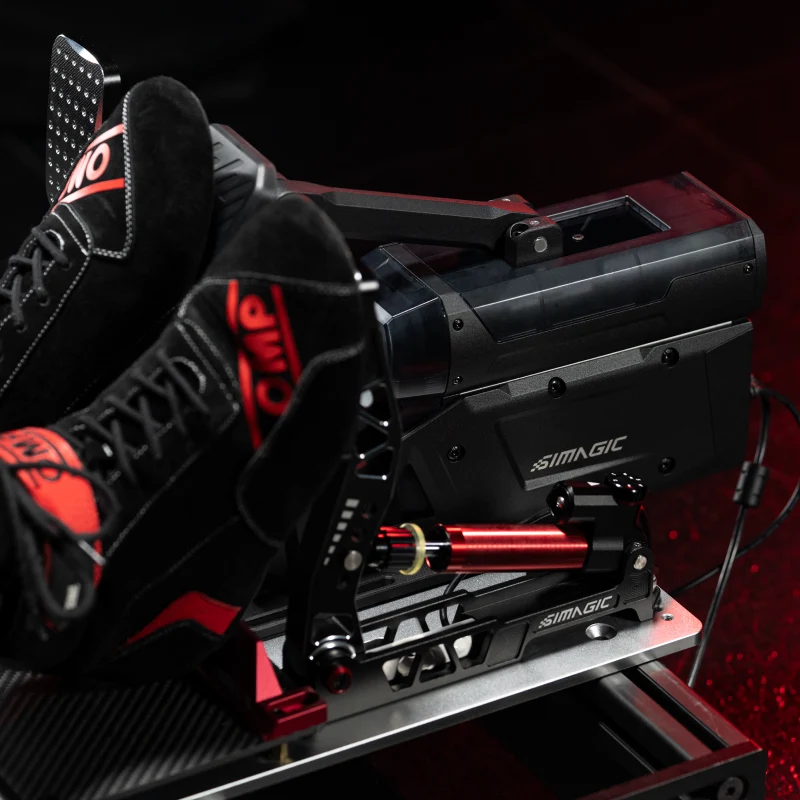
In sim racing, I often hear people talking about the pursuit of “realism”. I understand the appeal. We want our rigs to feel convincing, and we want to experience something of what a real driver feels.
But chasing a particular sensation without considering your own body can come at a cost. One setting stands out: the force needed to use the brake pedal.
I regularly hear that a GT3-style setup must have an extremely firm brake with hardly any travel. My question is simple: is that setting helping you drive, or are you fighting it?
A real car and a sim rig are different environments
Under heavy braking in a real car, deceleration changes the loads acting on the driver. The seat, harness and driving position all influence how the body is supported. A stationary sim rig does not reproduce those sustained braking forces.
That does not mean G-forces simply do the braking for a real driver. It means copying a pedal-force figure on its own does not recreate the whole experience.
Your seat position, pedal angle, reach and physical capacity matter. A setting that works for one person may be unnecessarily demanding for another.
Firmness, travel and braking input are different things
A pedal can have a firm feel while still allowing movement. Its mechanical resistance, its travel and the force you calibrate as maximum braking are related, but they are not interchangeable.
Real racing pedal systems also vary. There is no single setting that every sim racer must copy to earn the label “realistic”.
A firm pedal can work well. The problem is choosing a level of resistance because you think you should, rather than because you can use it comfortably and consistently.
Three things to watch for
1. Uneven physical demand
Repeated heavy braking places greater demands on your braking leg and can increase its strength and muscle size over time. I’ve experienced a noticeable difference myself. If you brake with your left foot, consider that extra workload alongside your training outside the rig.
2. Consistency that fades as the session goes on
You might be able to hit a high braking input once. Can you reproduce the input you need at the next corner, and again towards the end of a race?
If the effort is too demanding, fatigue may make it harder to reach your intended input or release the brake smoothly. That is a reason to review the setting, rather than assume more force will improve your driving.
3. Bracing, shifting or pain
Watch what happens to the rest of you when you brake. Do you slide in the seat, twist your pelvis, lock yourself into position or pull hard on the wheel to generate pressure?
The effort of braking is supported through your body and your contact with the rig. An unsuitable combination of force, reach and support may aggravate discomfort around the ankle, knee, hip or back. Pain is not proof that the pedal is the only cause, and it does not follow a fixed route through those joints.
If braking causes pain, stop the test and review what is happening. Persistent, worsening or unexplained symptoms deserve assessment by an appropriate healthcare professional.
Set the brake for repeatability
My starting point is control. Choose a braking force you can use without shifting your position, holding your breath or straining to reach it.
- Begin with a comfortable setting and change one thing at a time.
- Check your seat support, pedal reach and pedal angle alongside the force setting.
- Build up with short driving sessions, noticing whether your control or comfort changes with fatigue.
- Compare repeatability and brake release, as well as lap time.
- Reduce the load or stop if you develop pain, numbness or tingling.
Remember that “100%” on a calibration screen is a software input, not a universal amount of physical force. Nor is maximum braking the correct target at every corner or in every car.
Stop chasing a number. Start listening to your body.
Realism can be part of the enjoyment. But your sim rig should let you practise and race with control, confidence and comfort. If a softer or lower-force setting helps you do that, it is worth considering.
Adapt the rig around your body, not the other way round.
Explore our packages →